If you’ve ever worked with wire EDM, you know that small tweaks to your setup can make or break a job—especially when you’re chasing tighter tolerances, faster lead times, and less scrap. As a supplier of upgraded high-speed wire EDM systems, I get questions about pulse frequency more than any other technical spec. A lot of operators assume “higher frequency = better performance,” but that’s not the whole story. Let’s break down how pulse frequency actually connects to cutting efficiency, and why our upgraded systems are designed to balance that relationship for real-world production results. Upgraded High Speed Wire EDM

First, let’s ground this in what pulse frequency even means. In wire EDM, each pulse is a tiny electrical spark that melts a small chip of material from the workpiece. Pulse frequency is how many of these sparks happen per second, measured in kilohertz (kHz). For standard high-speed wire EDM (HS-WEDM) that’s been around for decades, frequency usually tops out around 10 kHz. But our upgraded models push that to 20 kHz, with variable adjustment down to 2 kHz depending on the material. That’s not just a number change—it’s tailored to how the sparks interact with the wire, the workpiece, and the dielectric fluid (the water-based coolant that flushes away melted material).
Let’s start with the basics of cutting efficiency here. Efficiency in EDM isn’t just how fast you remove material (material removal rate, or MRR)—it’s also about how evenly you remove it, how much wire breaks, and how little post-processing you need. If your sparks are too spread out (low frequency), each spark has more time to do work, but you’re not making the most of the wire’s capacity. The wire is a thin brass (or sometimes zinc-coated brass) electrode, and each spark consumes a tiny bit of it. If you only fire a few sparks per second, the wire isn’t being used as intensely as it could be—so you’re wasting wire capacity and stretching your production timeline.
But here’s where the balance comes in. If you crank frequency too high, two problems pop up fast. First, the dielectric fluid can’t flush away melted material between pulses. When a new spark hits before the debris (called “eroded debris”) from the last one is washed out, you get arcing instead of controlled sparks. Arcing is bad because it melts the workpiece unevenly, creates large, craters that need grinding later, and most importantly, burns the wire. A broken wire mid-cut means you have to re-thread it, re-align the workpiece, and start over—wasting hours, not just minutes. Second, very high frequencies can cause the wire to vibrate more, especially in thin workpieces. That vibration leads to inconsistent spark gaps, which means you have to slow down the cut to keep accuracy, erasing any speed gain from higher frequency.
This is where our upgraded HS-WEDM systems stand out. We didn’t just jack up the frequency—we paired it with two key upgrades that fix the flushing and vibration issues that hold standard systems back. First, we redesigned the dielectric fluid delivery: instead of a one-size-fits-all nozzle, our systems have programmable flushing pressure that syncs with pulse frequency. So at 15–20 kHz, pressure jumps automatically to 15 bar, which blasts away debris between every spark. For lower-frequency jobs (like cutting thick hardened steel, where debris is bigger), pressure drops to 8 bar to avoid bending the wire. Second, we added a closed-loop wire tension system that adjusts tension in real time as cut speed and frequency change. Most standard systems use fixed tension, so at high frequency, the wire sags and vibrates; our system keeps tension within ±5 grams, eliminating that vibration and letting us run 20 kHz reliably.
Let’s put this in concrete numbers to make it real. A customer of ours makes stamping dies for automotive parts, mostly from D2 tool steel (a common material for dies, 1.5mm thick). They were using a standard HS-WEDM system with 10 kHz frequency, cutting at 120 mm² per minute with a 2% wire break rate per job. When they switched to our upgraded system, they ran frequency at 18 kHz, with the tuned flushing and tension. Their cut speed jumped to 185 mm² per minute—54% faster—with the same surface finish (Ra 1.2 μm, which is perfect for stamping dies) and a 0.3% wire break rate. That’s not just a speed gain; that’s 3 fewer wire breaks per 100 jobs, which saves them over 2 hours of rework per week. Another customer does medical parts from 0.5mm titanium foil, which is super thin and prone to wire vibration. On a standard system, high frequency made the part wobble, so they used 6 kHz and cut at 45 mm² per minute. Our system runs 12 kHz, keeps the part stable, and hits 72 mm² per minute—60% faster, with no wobble-induced dimensional errors.
Of course, pulse frequency isn’t a one-size-fits-all setting. The sweet spot depends entirely on the workpiece material, thickness, and the required surface finish. Let’s break down how to match frequency to job type: for thick workpieces (over 10mm) like large mold bases, lower frequency (2–5 kHz) is better. The debris from thick material is larger, and higher frequency would cause arcing. For these jobs, we recommend setting frequency to 1 kHz below the threshold where arcing starts—our system has a built-in arc detection sensor that alerts operators to adjust automatically, so they don’t have to guess. For medium workpieces (2–10mm) like brackets or gears, 8–15 kHz works best, balancing MRR and surface finish. For thin workpieces (under 2mm) like medical implants or electronic connectors, 15–20 kHz is ideal, as long as the flushing and tension are tuned. This level of programmability is a big difference from standard HS-WEDM, which often locks frequency at a fixed 10 kHz.
I often get asked: why is this relationship different for our upgraded systems vs. older ones? It comes down to the wire quality too. Standard HS-WEDM uses brass wire with a 0.25mm diameter, and they run at high frequency by risking arcing and breaks. Our upgraded systems use a zinc-coated brass wire that’s 0.20mm for thin workpieces and 0.25mm for thick, with a uniform coating that reduces wire wear at high frequencies. We also integrated a pulse generator that delivers shorter, more controlled sparks—each pulse is 1 microsecond long, vs. 3 microseconds on standard systems. Shorter pulses mean less heat transferred to the wire and workpiece, so you can fire more sparks per second without damaging either. That’s a technical detail that makes the frequency-efficiency relationship work better than it ever has before.
Another often-overlooked factor: wire wear. Every spark eats a tiny amount of material from the wire, so higher frequency means more sparks, which means faster wire consumption. But if you pair high frequency with proper flushing, the sparks are consistent, not random, so you don’t get excessive wire wear in any one spot. On a standard system, the inconsistent flushing at high frequency leads to uneven wire wear, which causes breaks. Our system’s real-time flushing adjusts to keep debris clear, so wire wear is uniform even at 20 kHz. That means you go longer between wire spool changes—another hidden efficiency gain. A customer in aerospace was running 10 wire spools per week on a standard system; on our system, they only run 6, saving them $1,200 per month in wire costs alone, on top of faster cuts.
I should also address a common misconception: cutting efficiency isn’t just about speed. If higher frequency leads to worse surface finish, you’ll spend more time polishing the part after cutting, which cancels out any time saved. Our upgraded systems at 15–20 kHz produce surface finishes comparable to standard systems running at 8–10 kHz, because the shorter sparks create smaller craters. For jobs that require tight tolerances (±0.005mm), the uniform spark gap from the tension system means no dimensional variation, even at high frequency. That’s why precision shops don’t have to choose between speed and accuracy with our equipment.
So where does this leave operators? The key takeaway is that pulse frequency is a tool, not a metric to maximize at all costs. For high-speed wire EDM, upgrading the supporting systems (flushing, tension, pulse generation, wire quality) lets you push frequency higher without the usual downsides, leading to real efficiency gains: faster cuts, fewer wire breaks, less rework, lower material costs. But it’s only effective if you tune the frequency to your specific job, not just set it to the maximum.
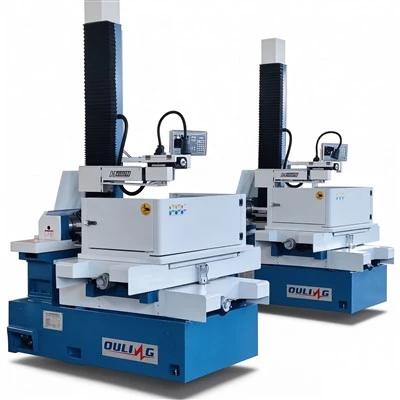
At the end of the day, that’s what we built our upgraded HS-WEDM systems to do: give operators the flexibility to adjust pulse frequency in a way that works for their production, instead of forcing them to settle for the limitations of older tech. If you’re dealing with slow cuts, frequent wire breaks, or rework eating into your production time, let’s talk. We can walk through your specific jobs, show you how our system adjusts pulse frequency to match your materials, and demo the efficiency gains you can expect without sacrificing quality. Don’t let old wire EDM rules hold your shop back—upgrade to a system that lets pulse frequency work for you, not against you.
Conventional High Speed Wire EDM References
- Kunieda, M., Lauwers, B., Overstances, C., & Rajurkar, K. P. (2005). Advancing EDM through fundamental insight into the process. CIRP Annals, 54(2), 64-87.
- Boothroyd, G., & Knight, W. A. (2006). Fundamentals of Machining and Machine Tools (3rd ed.). CRC Press.
- Desai, K. A., & Rao, P. V. M. (2010). Experimental study on material removal rate and surface roughness in high-speed wire electrical discharge machining of steel. Journal of Materials Processing Technology, 210(14), 1957-1965.
- Rajurkar, K. P., Levy, G., Malshe, A., & Bejarano, G. (1999). Micro and nano machining by electro-physical and chemical processes. CIRP Annals, 48(2), 579-597.
Taizhou Ouling CNC Equipment Co., Ltd.
As one of the most professional upgraded high speed wire EDM manufacturers and suppliers in China, we’re featured by quality products and good price. Please rest assured to buy advanced upgraded high speed wire EDM made in China here from our factory. Welcome to contact us for quotation.
Address: No. 9 jingang Road, Yangzhou City Jiangsu Province, China
E-mail: 574751243@qq.com
WebSite: https://www.oulingedm.com/
